Oh Errol ….
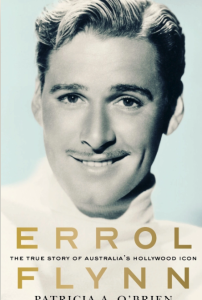
Errol Flynn: the True Story of Australia’s Hollywood Icon
Patricia O’Brien
Golden Age screen hero, silver-tongued charmer, tough-as-nails swashbuckling sailor, swordsman and horseman with a virtual patent on historic hero roles. Dripping with money, ridiculously handsome and a back story of real adventures – every woman wanted him, every man wanted to be him.
So the conventional wisdom goes. But I’m not so sure I’d give everything just to be like him, as Aussie Crawl’s Guy McDonough sings.
When things were good, they were very good. When they were bad, they were very, very bad. Fast, furious and fantastic as Captain Blood’s reign in the limelight was, Flynn’s course around the sun was ultimately short-lived and pathetic, badly fractured by drugs, booze and a faltering grasp on reality.
Author O’Brien, fascinated by the man and the legend, seems at pains at the outset to cement Flynn in the category of Weinstein, Epstein and the casting couch cabal that’s run Hollywood for decades. And there seems little doubt he paired up with more than a few ingenues busting to get him to get them into Tinsel Town. But the portrait she paints of the Tasmanian megastar is far more complex, pegged by some 50 pages of notes and bibliography references.
Truth is, it’s doubtful Hollywood’s hosted a heartthrob more arresting, magnetic, exciting or rakish than Errol Flynn. Or troubled, because to his CV you can safely add fabulist, wife-beater, heroin and coke junkie, blotto alcoholic, hot-headed brawler …
“Don’t tell me it’s true, I don’t wanna hear about it”, as McDonough says. Oh Errol.
Unlike Flynn’s own My Wicked Wicked Ways autobiography, ghosted by Earl Conrad, O’Brien places his adventures, achievements, and failures, against the straitened social, moral and political contexts of the day, as well as today.
Hypocrisy is writ large, and often, but Flynn’s far from the only guilty party. His actions are aided, abetted and, perhaps most notably, forgiven by an adoring public every bit as addicted to him as he is to the superstar lifestyle. It’s a curious mirror on human behaviour.
The Flynn story remains rivetting nonetheless. His Tasmanian childhood, his Sydney years, are detailed comprehensively. Likewise, his teenage years abandoned in England public school system. His parents’ fortunes and careers are spelled in similar detail, as are his relationships with them, deferring favourably to his father while highly critical of his mother.
His New Guinea years overseeing copra and tobacco operations, his sailing adventures, writing and early acting efforts are all mapped out in a sharp contemporary context that stresses Flynn’s predilection for colonial-style management and attitudes. He might have easily made a plantation slave-master is the clear impression O’Brien delivers while rejecting Nazi spy claims levelled against Flynn.
As for womanising, and teenager-ising, it’s fair to say the apple didn’t fall far from the tree given Flynn’s old man Theodore’s philandering. Mum Marelle had more than just cause to cast her eye elsewhere. Flynn expanded the role exponentially, amid three marriages and an infamous rape trial.
O’Brien tracks Flynn’s movies and their production doggedly: Blood, Robin Hood, Sea Hawk, Charge of the Light Brigade, Santa Fe Trail, Don Juan, his numerous westerns – together with his co-stars, his work schedules, hard-nosed contracts and demands, and the eventual souring of all the above.
As age, health and dissolute lifestyle caught up with him, his career came under a cloud as did his finances. Grand plans on a Jamaica plantation, which looked promising for a while, failed to eventuate. Likewise, efforts to resurrect his film prospects. Taking up with a 15-year-old girlfriend while filming the Cuban Revolution, alongside Fidel Castro, perhaps highlights the degree of fame and farce of his final years.
Ultimately, getting sense out of Flynn was hard work at best, as Earl Conrad learned. His death at age 50 was a foregone conclusion. Same goes for his ongoing popularity, both assisted and perpetuated by O’Brien’s compelling if rather academic account of this intriguing celebrity.