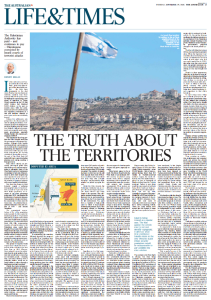
The truth about the territories
The propaganda war over Palestine continues unabated and largely unchallenged by Western media or politicians, as outlined here by Henry Ergas.
In the controversy over Israeli settlements in the West Bank – as in every
other aspect of that intractable conflict – the facts have disappeared in the
dust storm. Plainly erroneous claims are endlessly repeated, from those
made by British Foreign Secretary Ed Miliband in announcing a new round of
sanctions to Penny Wong’s assertion at the UN that settler violence had
displaced 15,000 children in the past six months alone.
With the settlements cast as the root of all evil, and any expansion condemned as a vast and
insidious obstacle to peace, basic realities are steadfastly ignored.
Putting the settlements into perspective is the obvious place to start in
righting the balance. Government-authorised settlement in the West Bank
began in 1967 under Levi Eshkol’s Labour-led government and expanded
under subsequent governments, especially Yitzhak Rabin’s first Labour
government of 1974-77.
The settlements thus long predate the Oslo Accords, much less the
governments of Benjamin Netanyahu. Although their legality was disputed
then, and remains so, the Accords neither required their dismantling nor
imposed a settlement freeze. Reflecting the territorial arrangements the
Accords established, almost all lie in Area C, the part of the West Bank left
under full Israeli control, including planning and zoning, pending a final
agreement.
Built almost entirely on previously unoccupied public land, their built-up
area has been and remains a minuscule share of the West Bank’s territory.
Settlements covered just 1.7 per cent of that territory in 2010; their footprint
has since expanded to some 2 per cent, mainly because of an increase in the
number of dispersed outposts with a mere handful of inhabitants.
Nor does the change in their footprint suggest a galloping demographic
takeover. Israeli settlers account for 15 per cent of the West Bank’s
population, an increase of just three percentage points since 2010.
And despite the proliferation of scattered outposts, that population remains very
heavily concentrated in blocs near the Green Line – the armistice line
established between Israel and Jordan in 1949 – and around Jerusalem.
The geographical concentration of the settler population matters greatly. In
effect, under the detailed parameters US president Bill Clinton proposed in
December 2000 (and which Israel accepted), annexing just 5 per cent of the
West Bank, with fully compensating transfers of Israeli territory to the
Palestinian state, would have brought 80 per cent of the settlers within
Israel’s borders.
A two-state solution was therefore technically feasible
without having to remove a vast number of settlers, even assuming the peace
agreement specified that no settlements were to remain in a Palestinian
state.
The spread of outposts would require more settlements to be removed under
a Clinton-type deal today than in 2000. However, those outposts have so few
inhabitants that the total number of settlers who would have to move has
not increased greatly – meaning that a two-state solution, were it politically
feasible, would not be vastly harder to achieve through a land swap now than
it was then.
Claims that mere increases in the settler population are, in themselves, an
obstacle to a peace deal are consequently seriously incorrect. But that hasn’t
stopped governments, including our own, from their incessant
condemnation. The latest sanctions, imposed by the UK, France and Canada
among others, are simply the most recent expression of that enduring
hostility. Yet the grounds on which they are based – the plans to build in the
E1 corridor and the issue of settler violence – are scarcely adequate
justifications.
Much invoked and little understood, E1 is 12sq km of open ground in the
West Bank that lies between Jerusalem and Ma’ale Adumim – a city of about
38,000 whose residents overwhelmingly commute to Jerusalem, making it in
practice a suburb of the capital.
In announcing the sanctions, Miliband described the proposals to develop E1
as “crossing a longstanding red line”. Yet Israel’s commitment to developing
this sliver of territory is neither recent nor the invention of alleged rightwing extremists.
First authorised by Rabin in the 1970s, it was further
elaborated by Shimon Peres and elevated into a vital national security
concern by Ehud Barak. As for retaining Ma’ale Adumim and its link to
Jerusalem within Israel, it has been a consistent feature of Israeli negotiating
positions since the suburb was first mooted 50 years ago.
Nor is there anything in the present proposal’s scale that could possibly
justify the uproar. Its 1234 residential units, along with a commercial and
industrial zone, would occupy just more than two square kilometres out of
the West Bank’s 5700 – less than four-hundredths of 1 per cent. Even at 3.6
occupants per unit, the homes would increase the settler population by well
under 1 per cent and the West Bank’s total population by a tiny fraction of
that.
When a far more expansive plan, of which this is the first stage, was
approved in August 2025, the Starmer government issued a formulaic
statement of concern – a restraint that makes the sincerity of its outrage now
that much harder to credit.
The claim that developing E1 would destroy the contiguity needed for a
Palestinian state is no sounder. To begin with, the E1 corridor does not reach
the Jordan River, as it would have to do to split the West Bank in two. A
north-south passage would remain east of Ma’ale Adumim – and it would be
as wide as, or wider than, Israel at its narrow coastal waist. A width deemed
perfectly sufficient for Israel can hardly, in itself, make a Palestinian state
unviable.
Beyond territorial contiguity, critics argue that Palestinians would lose
north-south transport links under their own control. Yet Israel has invested
specifically to preserve those links. It compulsorily acquired 1.41sq km of
land in 2007 and spent close to $138m on Route 4370, which opened in
January 2019. In March 2025, the government committed a further A$154m to
extend the road south around E1 to al-Eizariya.
The case against E1 is therefore untenable. The question of violence is more
complex – and more troubling.
Any serious account must begin by recognising that the violence is far from
one-sided. Attacks on settlers intensified during the Second Intifada and
have continued, at varying levels, ever since.
In 2024, there were 6343 attacks on Israelis in the West Bank, leaving 27 murdered and more than 300
seriously wounded. The number of attacks declined in 2025, but not the toll
they exacted: there were 5051 attacks on settlers, with 24 murdered and more
than 400 seriously wounded – and the lethality of the attacks has picked up
again this year.
Under the Oslo Accords, the Palestinian Authority has an explicit duty to
investigate and prosecute those offences and notify Israel of the outcome.
That obligation matters because many perpetrators live in, and retreat into,
areas where the PA is responsible for law enforcement. \
Yet, apart from a handful of high-profile cases in which it faced intense international
pressure, the PA has constantly refused to discharge that duty. Instead, it has
paid – and continues to pay – Palestinians convicted of terrorist attacks by
Israeli courts, openly boasting of its support.
In 2025, the United States cited the PA’s continued incitement and
glorification of violence when imposing sanctions. Australia, Britain, France
and Canada have not shown comparable resolve: they have left the PA’s
active promotion of attacks on Israelis entirely unpunished. While repeatedly
sanctioning Israeli ministers accused of tolerating or fomenting settler
violence, they have imposed no sanctions whatsoever on the leaders of the
PA who brazenly urge attacks on settlers and prevent their perpetrators from
being brought to justice.
Appalling as it is, that asymmetry cannot excuse settler violence. Although
Palestinian attacks on settlers remain far greater in number and severity, the
United Nations reports that recorded settler attacks rose from 535 incidents
in 2021 to 1828 in 2025. Those figures should not be taken at face value: they
have been marred by extensive double counting and by a definition of
“violence” that has, on occasion, included the mere act of entering the
Temple Mount.
Nor is Wong’s statement “that in just the last six months, settler violence
has driven 15,000 children from their homes” plausible: the UN itself reports
an estimate of about 1300 over that period, and going by careful analyses of
past UN estimates, that is likely to be a significant overstatement.
But while those claims lack credibility, uncertainty about absolute levels does not
negate the fact that settler violence has grown, especially recently.
Three factors appear to be at work. The first is the arrival in the West Bank of
an estimated 300- 400 severely disaffected young Israelis. Some embrace
religious messianism; others resemble violent anarchists; many live in
makeshift outposts and transient encampments. Their motives are difficult
to fathom; what is certain is that their actions receive a prominence
mainstream outlets never accord to attacks on settlers.
The second is the pressure on Israel’s armed forces. Continuing threats in
Gaza and along the Lebanese border have drawn the Israel Defence Forces’
most experienced troops to those fronts. Patrolling the West Bank has
consequently been left to conscripts fresh out of high school, who lack the
extensive training, experience and discipline dealing with violent offenders
demands.
Divided jurisdiction between police and the IDF, the apparent
sympathy for the Jewish offenders by some soldiers, and the reluctance of
National Security Minister Itamar Ben-Gvir to allow police to crack down on
violent offenders have all aggravated the problems that causes.
Last but no less significant is the corrosive effect of prolonged war. Hamas’s
savagery on October 7, followed by a conflict of exceptional duration and
intensity, has further embittered relations between Palestinians and Israelis,
making the West Bank a tinderbox. With fear and distrust pervasive on all
sides, violence becomes easier to commit and easier to condone.
Deplorable as that situation undoubtedly is, Miliband’s contention –
predictably echoed by UN secretary-general Antonio Guetteres – that settler
violence amounts to state-endorsed ethnic cleansing is absurd. Ethnic
cleansing means precisely that: removing an existing ethnic group from the
territory, entirely or close to it.
That was the case, for example, with the expulsion of the Jews from the Arab
lands and Iran over the period from 1943 to 1965. In contrast to the chaotic,
largely unplanned, flight of the Palestinians during the Israeli War of
Independence, those expulsions’ scale, persistence and severity deliberately
erased communities that long predated Islam, reducing the Jewish
population in the Muslim Middle East from 946,000 to less than 10,000.
More recently, after Turkey invaded Cyprus in 1974, the entire Greek Cypriot
community – some 150,000 people – fled or were expelled, leaving fewer
than 100 Greeks in Turkish-controlled northern Cyprus; the Greek Orthodox
were then deliberately replaced by tens of thousands of Muslim settlers from
the Turkish mainland. Turkey is now doing much the same in parts of
northern Syria, where Kurds are being expelled from their traditional
homelands. Last but not least, Azerbaijan’s conquest of Nagorno-Karabakh
in 2023 was followed by the complete removal of the region’s 100,000
Armenian Christians, with only some 10 Armenians (who were too old and ill
to travel) remaining behind. There too, Azeri settlers were moved into the
homes of those who had been expelled or forced to flee.
The contrast to the West Bank is obvious. Far from being “cleansed” out of
the territory, the Palestinian population has grown from about two million in
2000 to 3.3 million in 2024 – an increase of roughly two-thirds in just over
two decades.
There is no sign whatsoever that growth has been slowed by any
Israeli government, much less that any credible Israeli government could
believe removing the Palestinian population was feasible. And no Israelis
have ever been moved to the West Bank by the Israeli government, rather
than settling there by choice.
But Miliband’s political posturing inadvertently highlights a crucial point.
Not a single one of the Muslim states sponsoring and directing the regions’
recent instances of real ethnic cleansing has been sanctioned.
In fact, despite fierce attacks by Turkey on the Syrian Kurds, no international sanctions have
been imposed on Turkey, any more than Turkey has been sanctioned for its
continued transfer of population to occupied Cyprus. Equally, despite still
widespread attacks by Syrian military and paramilitary forces on the
country’s Druze, Alawite and Christian minorities, the sanctions imposed on
the Assad regime are being dismantled. And there are no sanctions
whatsoever on Azerbaijan.
It is therefore plain that Israel is being treated as a special case. The bias
against the Jewish state is not just morally repugnant; it destroys what little
confidence Israelis retain in the very Western states whose security
guarantees would be indispensable to any credible two-state solution. It also
convinces Palestinians that time is on their side, further weakening the
incentive to negotiate.
The result is to reinforce, perhaps irreparably, the conviction Israelis already hold that the other side is implacably and
homicidally hostile, putting reconciliation beyond reach.
It is impossible to think of any way in which the recent sanctions improve
that situation.
Rather, what is needed are credible measures that encourage
not only Israelis but Palestinians to enforce the rule of law on the West Bank.
And while Israel needs to do more to deter, arrest and punish any settlers
who engage in violence, it is undeniable that the Palestinian Authority
remains a fundamental obstacle to assuring the rule of law.
That is partly because of the PA’s refusal to direct its police force to
effectively crack down on the violent offenders who assault and murder
Israelis on the West Bank and in Israel itself. But the rule of law requires
more than mere policing – it also requires independent courts that are
committed to ensuring all parties, including minorities, benefit from the
laws’ equal protection.
Yet PA president Mahmoud Abbas has made it clear
that he has no intention whatsoever of moving in that direction.
He has, on the contrary, demolished the judicial independence the
Palestinian Basic Law of 2003 (that serves as the Palestinian constitution)
was designed to protect. Significant sections of the Palestinian judicial
system objected strenuously; but – with the exception of the US – they
received no practical support from Western governments, which continued
to bankroll the PA.
Nor did the Western media pay the slightest attention to
the destruction of the Palestinian judiciary, instead focusing to the point of
obsession on the Netanyahu government’s proposed changes to the Israeli
judicial system.
That has left Abbas free to issue 400 decrees touching the judiciary alone.
When the Supreme Court voided his choice of chief justice, he created a
constitutional court and staffed it with judges who had never ruled against
him. In 2019, 11 days after even that court struck down his judicial retirement
decree, he retired 19 senior judges, including 12 who had brought the case.
Thanks to those manoeuvres, Abbas sits at the head of every judicial body in
Palestine, leaving law enforcement drenched in corruption, arbitrary in
execution and permeated by human rights abuses.
And it is Abbas or his handpicked successor who would preside over an independent Palestinian
state, further hardening Israeli opposition to that state’s formation.
To make things worse, Abbas has repeatedly portrayed the settlers as entirely
undesirable aliens.
He has insisted that voluntarily selling West Bank land to
Israelis who wish to live there amounts to treason, turned a blind eye to the
torture and assassination of alleged sellers by Palestinian security forces, and
insisted Palestinian courts punish any sellers who go to trial with life
imprisonment.
Moreover, in implementing that prohibition, the Palestinian
Supreme Court has referred to it as a ban on selling land to Jews, highlighting
its manifest antisemitism. Last but not least, a requirement for the
settlements to be removed has been a persistent feature of the Palestinian
position in successive negotiations. Decades of bitter conflict help explain that hostility.
Even so, it is not self-evident why a future Palestinian state could not accommodate a Jewish minority, just as non-Jews constitute 26 per cent of Israel’s population. And the insistence on removing the settlers is particularly difficult to reconcile
with their substantial contribution to the West Bank’s economy.
Thus, spending on construction, maintenance and consumer goods and
services has directly boosted Palestinian incomes, while the settlements
underpin a thriving productive sector that, unlike most of the Palestinian
economy, does not depend on development assistance.
According to the World Bank, Israeli firms operating in the West Bank pay Arab workers wages
that can reach or exceed twice those available in Palestinian firms, generate
20 per cent of the area’s GDP and account for an even larger share of its
private economic activity.
The insistence on expelling the settlers, despite those economic benefits,
reflects the same underlying intolerance that has driven the wholesale
expulsion of Jews from the Arab Middle East, the elimination of the
Mandaeans, the incessant attacks on groups such as the Yazidis, Baha’i,
Zoroastrians and Copts, and the precipitous decline, from 10 per cent in 1950
to less than 3 per cent today, in the Christian share of the Arab states’
population.
At its core is a virulent opposition to tolerating any religious
diversity whatsoever in territories regarded as historically Muslim lands.
Until there is credible evidence of some change in that attitude, including
and especially from the PA, it will be hard for Israelis, and even more so the
settlers, to readily accept a two-state solution. And just as a new Israeli
government needs to effectively deter and punish settler violence, so the PA
must be demonstrably committed to ending its antisemitic rhetoric,
stopping terrorism and upholding – as the Oslo agreements demand – the
rule of law.
The central obstacle to peace is therefore political, not a matter of geography
or of population. Land swaps could, if necessary, accommodate the great
majority of settlers; they cannot supply the security and mutual confidence
on which coexistence depends. Both governments must be genuinely bound
by their obligations if that confidence is to take root.
Yet the Western governments imposing sanctions on Israel, including our
own, invoke a two-state solution while doing nothing to secure its
indispensable conditions.
Their sanctions have become a substitute for a policy capable of bringing peace closer, leaving the two-state solution a
platitude to be piously recited even as their actions make it ever less likely.
But that doesn’t seem to trouble them in the least: so long as they can be
seen to punish Israel, they are content.
As for the cost in human lives, that is for others to bear.
This story appeared in The Australian 29 September 2026