Ghost towns are always curious affairs. Victoria has no shortage of them, what with the massive number of gold strikes and hopefuls digging willy-nilly across the state back in the 19th century.
Some were significant townships, others small jobs, others again little more than temporary, even mobile, camps. Some were specifically gold, others farming or general servicing arrangements.
Construction projects produced tent settlements, pitched canvas towns, notably with railway lines that were peppered liberally across the state, linking farming, goldfield, forestry and other communities.
The Geelong region has had various tiny townships slip into the mists of history, some remembered, some not, some morphed into present-day towns: Germantown, Clifford, Irishtown, Kildare, Cocoroc, Duck Ponds, Manor, Steiglitz, Eclipse, Swampy Creek, Mangowak …
Few people know much, if anything, about Viaduct even though it was home to 2000 people, with 800 men working its adjoining Moorabool Viaduct project at any one time.
All goes back to 1858 when the railway bridge build across the Moorabool River started, and the next 20 years or so.
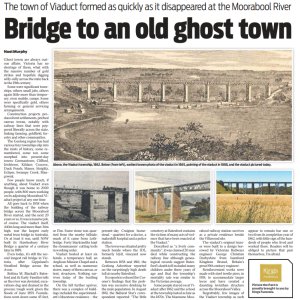
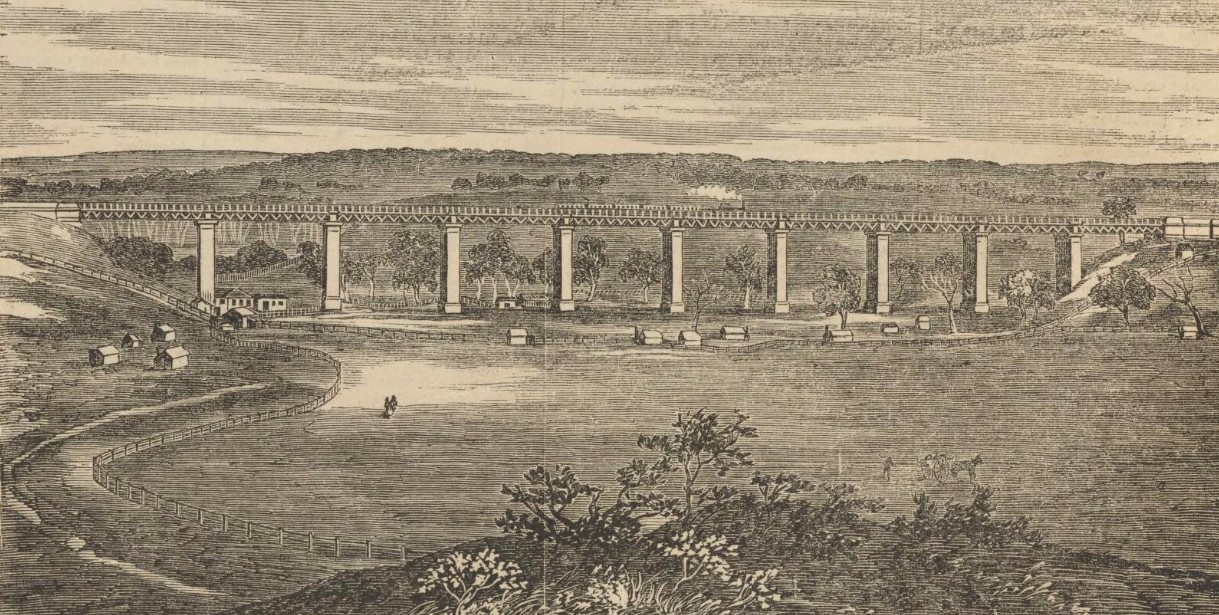
Massive job, of course. The viaduct itself, 440 metres long and more than 34 metres high, was the largest early metal truss bridge in Australia. Or at least it was, until NSW built its Hawkesbury River Bridge a quarter century later in 1889.
Even today, it’s still the second longest rail bridge in Victoria, after Gippsland’s Stratford Bridge across the Avon.
Bettina M. Blackall’s Batesford and its Early Families tells us the river was deviated, excavations dug and drained in the process; tough work given the floods of June 1959. Foundations went down some 45 feet, or 15 metres.
Some stone was quarried from the nearby hillside, much of it came from Lethbridge. Forty blacksmiths kept the stonemasons’ cutting tools in working order.
Viaduct hosted at least six hotels, a temperance hall, an Anglican Mission Chapel and a school, as well as numerous stores, many of them canvas, or tent, structures. Nothing survives today of the bustling township.
On the hill further upriver, a complex of buildings included the superintendent’s bluestone residence – the present-day Craigton homestead – quarters for a doctor, a makeshift hospital and a police station.
The town was situated pretty much beside where the IDL, formerly Idyll, vineyard now stands.
Interesting place. Between 1858 and 1861, the Geelong Advertiser reported on the surprisingly high death toll at nearby Batesford.
Its reporters echoed the Coroner’s findings that the problem was excessive drinking by the male population and in August 1861 the Ballarat Star’s correspondent reported that “the little cemetery at Batesford contains the victims of many acts of violence that have been enacted at the Viaduct”.
Described as “a lively community”, it was claimed 20 men died while constructing the railway line although genealogical records suggest Batesford’s death toll included many children under three years of age and that the township’s mortality rate was similar to the Victorian average.
Some people stayed on at Viaduct after 1862 and the school at the township lasted as late as the 1870s. The bluestone Moorabool railway station survives as a private residence beside the Villawood site.
The viaduct’s original trusses were built to a design borrowed by Victorian Railways engineer George Christian Darbyshire from Isambard Kingdom Brunel, Britain’s great 19th century engineer.
Reinforcement works were made with steel trestle piers, in 1918, to accommodate larger locos and have created a daunting leviathan structure across the Moorabool Valley.
Regrettably, few images of the Viaduct township as such appear to remain bar one from its completion year 1862 with little sign of the hundreds who lived and worked there. Readers will be obliged to picture that past themselves, I’m afraid.
This story appeared in the Geelong Advertiser 7 September 2026.