Never seems any lack of material for the tinfoil hat brigade to chew their nails over regarding government or alien mind control conspiracies. Few of them, if anyone, however, seem terribly interested in real things that might actually fall on our heads.
The White House alien watch has just released its fifth drop of UFO files, files which Trump likes to think of as “highly complex, but extremely interesting and important, matter”.
Frankly, they’re pretty uninspiring, dull and the sort of obvious scams that should have been poo-poohed when first encountered. Highly complex? Yeah, nah.
But we all love alien stories.
Former POTUS Obama recently opined that aliens were “real” although with a rider, “but I haven’t seen them”. Tucker Carlson suggests UFOs are “spiritual entities” while Veep J.D. Vance believes they’re “demons”. True brains trust stuff.
Not so Twilight Zone, meantime, are accounts of real space junk. The stuff that’s flaming through Earth’s atmosphere and crashing into populated regions at meteoric speeds.
Take the six solid spaceballs found recently near Townsville, reportedly pressure vessels from a space launch vehicle.
And the giant metal dome that washed up on a WA beach near Perth in 2023 from an Indian satellite rocket.
A spherical object found in Namibia some years back gives an idea of what can come crashing dangerously back to earth – a fuel tank containing the highly volatile propellant hydrazine from an unmanned rocket.
Then you have a separation ring from a space launch rocket that spudded into Kenya last year weighing 500kg and 2.5m wide. It’s had been orbiting Earth for something like 16 years.
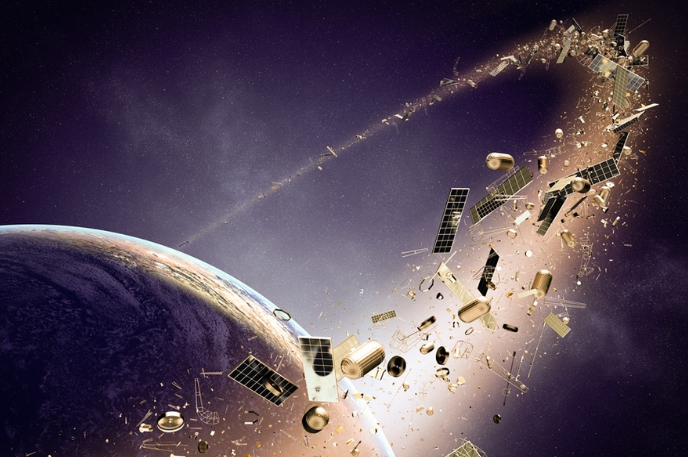
Right now, there are some 30,000 pieces of space junk 10 cm or larger orbiting the planet. Count the smaller bits and pieces and you’re talking about 130 million.
Think bits of rockets and machinery, cactus satellites, tools dropped by clumsy astronauts, even tiny tings like flecks of paint off spaceships – all capable of smacking into satellites that are providing all manner of info to we mortals below; meteorological, GPS, banking, emergency services, IT comms, agricultural stuff …
It’s a full-on rubbish tip up there. And it’s all whipping along around eight kilometres a second, that’s 29,000kmh and eight times faster than a bullet.
You’re talking a hyper machinegun salvo if you run into even a handful of the stuff. Rip you into a gazillion celestial smithereens.
Which, of course, is worrying news for the owners of the 16,000+ working satellites in Earth’s orbit hoping they don’t meet any hit-and-run incidents. That 16,000 is tipped to hit 60,000 in the next three or four years, by the way.
The good news for we Earth-bound misfits is that most space junk disintegrates if belted downwards out of orbit into the god-awful friction of the atmosphere.
Not so much for any future denizens of the thin atmosphere Moon in the wrong place at the wrong time.
Wouldn’t have fancied being under the rocket from Elon’s SpaceX Falcon 9 when it crashed into the Moon couple weeks back after drifting about in an uncontrolled orbit for 18 months.
That’s a four-tonne lump of metal coming in at 8700 kmh; the sort of numbers that might make you swap your tinfoil hat for a fully-fledged Count Binface lid. Not that it’s likely to do you much good
This article appeared in the Geelong Advertiser 18 August 2026
Image: MIT News