Sad to see the highest landscape feature of the once-sleepy hamlet of Fyansford is now its rubbish tip. Talk about a blot on the landscape with its shipping containers and cyclone fencing around the perimeter as if they might stop the southerlies and westerlies blowing detritus across the township.
The old Fyansford landscape’s taken a fair whack or two down the years at what is now a violently fast-growing suburb near the confluence of the Barwon and the Moorabool rivers.
Think limestone, sand and bluestone quarries, soaring cement works chimneys and silos, rail lines, airborne conveyors, viaducts, tunnels, a realignment of the Moorabool and, over time, three chief road bridges and a major road cutting.
That’s not to mention what’s also missing; a waterfall that once cascaded where the tip now is, that’s vanished down the years, or the timber trestle train bridge searchers trawled beneath looking for missing boy Russell Rushton before he was found murdered in the 1960s.
Likewise, the tall palms at the bottom of The Deviation as well as the old tracks below The Deviation leading down to the orchard/flower farms that once occupied the flood plains below.
You’d be hard-pressed, also, to find cattle colliding with cyclists coming down Hyland Street these days. Or horses bursting their boilers hauling cement carts up the same hill, a torment captured in Van Walker’s song Heavy Laden Drays.
That’s also not to forget the little that’s left of the Swan Inn, the original Fyansford pub, where writer Rolf Boldrewood looked down his nose at the owner’s wife, mistaking her for a maidservant before apologising for his faux pas. What an insult, treating a gentlewoman as a servant.
Visit Fyansford today and these historic milestones are eclipsed or superseded by hundreds of new homes in two new estates, by new business precinct buildings, by a large vacant site pencilled in for a shopping centre, and by hundreds of cars at the pub’s pokies, the adjoining common’s dog park or maybe a wedding across the road.
Place is changing, has changed, big time.
The town was named for Geelong’s pioneering police magistrate, Foster Fyans, who earned himself the sobriquet ‘Flogger’ for his appalling cruelty towards convicts while previously commandant at Norfolk Island. He set up camp at Fyansford before setting up home in present-day Balyang sanctuary.
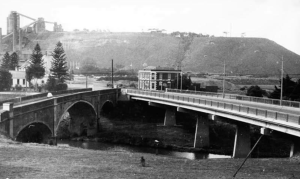
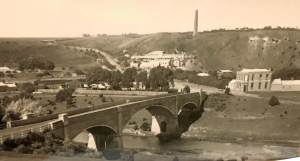
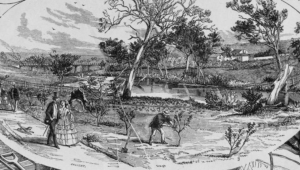
Scrutinise any of the old images of Fyansford and you’ll find the pub looks the same, Balmoral too, but the old arched bridge is covered in foliage, the nearby Herne Hill hilltop is peppered with new homes, cement works are gone, the plains around the paper mill built up and thickly vegetated.
Gone too are old Kombis that lived beside the primary school. So too the adjoining tennis courts. Mind you, you’ll find a double decker bus up De Goldis Road.
Trees at the top of the cutting, where cops liked to hide to nab leadfoot drivers coming up the hill, have been ripped out. A large ugly unfinished shed frame seems to possess better survival skills that just about anything else in the town.
The bridges, of course, are what Fyansford’s always been about.
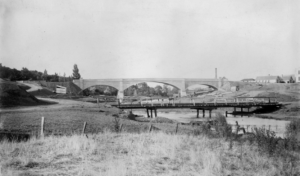
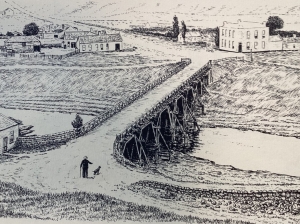
The earliest was a wooden job that operated from 1854 to 1899, built to carry diggers to and from the goldfields but subject to floods and the need for maintenance. A temporary bridge was washed away by floodwaters during early repairs.
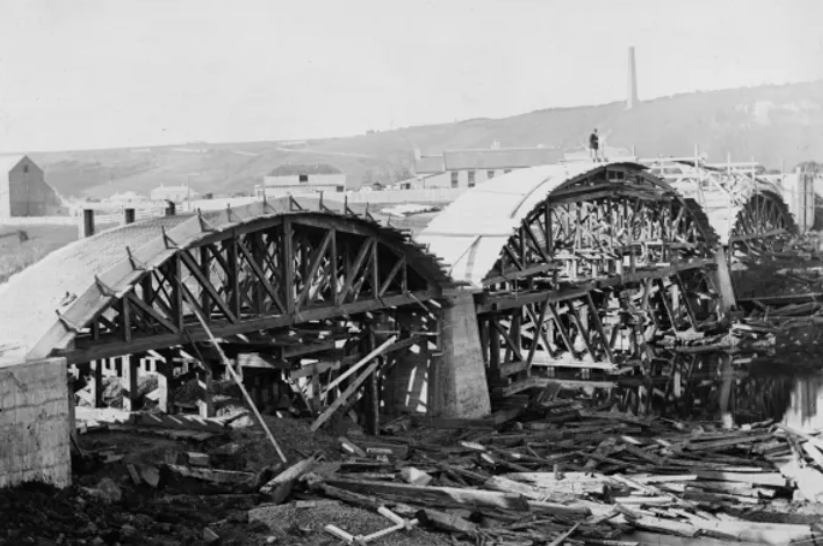
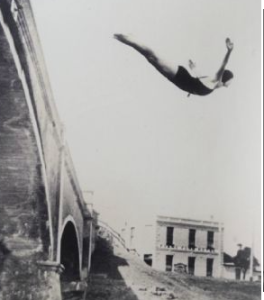
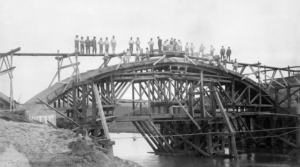
Another temp bridge went up downstream as the arched bridge was built in 1899, famously by John Monash using a Monier reinforced concrete design. Construction images show a mass of timber framework while a delightful fake photo later on, from around the 1920s or ’30s, has a woman swan-diving into the Moorabool shallows below.
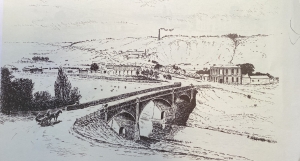
This bridge had its own issues, with cracks emerging a few years later, but worked well enough until 1970 when a newer, larger T-beam concrete iteration was erected. It’s getting more work than ever now, as heavy traffic pours in from the ring road and new estates.
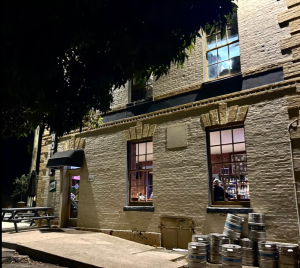
One place where little has changed is the front bar of the pub with its old-world timber bar, exposed brickwork and punters happy to propound on the nature of change and its effects on the local surrounds.
You can peer through the window and watch the tip edge its way higher, it’s 30 metres above the bridge, 10 metres higher than the adjoining Hamilton Highway, according to Google Earth, and still growing.
This article appeared in the Geelong Advertiser 18 May 2026.