Geelong’s love affair with the bottle is a lengthy one. Breweries, distilleries and vineyards are commonplace across the region, a substantial little economic sector in their own right, even if occasionally backyard operations.
Craft beers brewed and flavoured by fertile imaginations, wines from at least three different terroirs, gins galore, whiskeys, spirits, home brews, bootleg grappa, rakia – they’re all out there, from vodkas to poteen, schnapps to shoosh!
While the industry’s always been rather fertile, brewers willing to raise their business heads above the ramparts, in an historical sense, are rather rare. Count them on less than two feet, in fact.
Early days Geelong, mid-1850s, hosted just two brewers; John Cumming’s in Corio Street, later to become Volum’s, and Thomas Aitkin’s, later Thomas Powell’s, Corio Brewery, in Little Malop Street.
A decade later, despite the roaring days of the Gold Rush, and a squillion pubs and desiccated drinkers in the region, only a modest handful of brewers existed. These included players such as the Pivot Brewery, attached to the Clare Hotel in Bellerine Street, Treacy’s West End Brewery on Latrobe, near the railway station; and Walker’s South Geelong Brewery in Fyans Street.
The Hodges and Volum families were the pre-eminent booze producers in town.
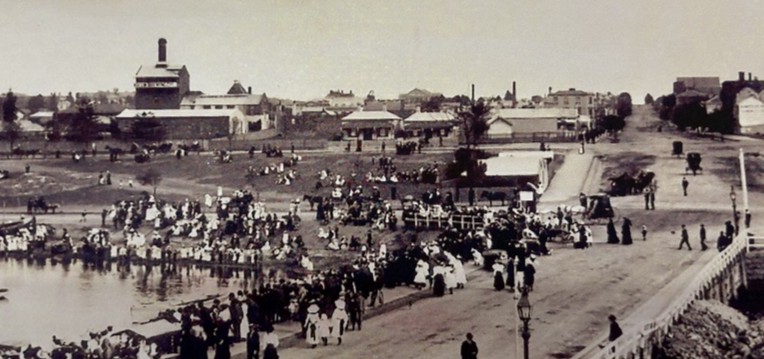
Heritage architect David Rowe’s About Corayo tells that in 1868, Isaac Hodges opened the Royal Brewery in the former Theatre Royal, Malop Street. His sons Frederick and Harry subsequently ran things and the business became the Hodges Brothers. They took over, and transferred their operations to, the West End Brewery on Latrobe.
Impressive old building, with its two-storey brewery, now long gone. A sterling image of the enterprise was penned by artist-architect John Stuart Jackson in his magnificent 2.5-metre-long diorama of Geelong, Geelong from Sheehan’s Terminus Hotel 1891.
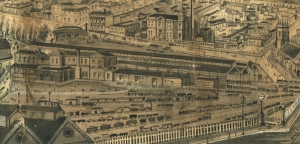
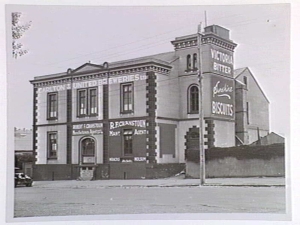
The brewery owned a dozen or more pubs around Geelong town to dispense its libations and by 1890 was producing 1700 dozen bottles a month and 14,000 gallons of draught. Carlton & United bought the lot in the mid-1920s.
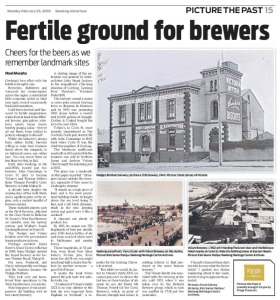
Volum’s, in Corio Street, more recently remembered as The Scottish Chiefs pub, started life with John Cummings in 1845, back when Corio Street was the chief thoroughfare of Geelong. The bluestone malthouse was built in 1851 and in 1856 the business was sold to brothers James and Andrew Volum. They bought the adjoining pub in1865.
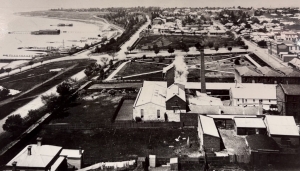
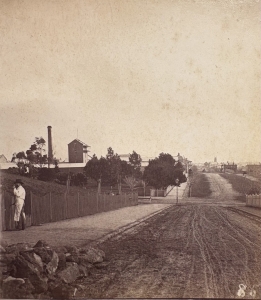
The place was a landmark. As this paper reported: “Strangers cannot mistake the brewery, especially if they come to Geelong by steamer. It stands on a high piece of land, and is the most prominent building visible; its height above the sea level being 75 feet, and a tall brick chimney, stuck in the rear, keeping watch and guard over it like a sentinel.”
It churned out plenty of product. By 1891, its output was 350 hogsheads of beer per month, plus 2500 dozen bottles of ale and stout, much of which went to Melbourne and nearby towns.
Those hogsheads, at 54 gallons, were about four times today’s 50-litre jobs, three times the old 18-ers you might recall and half a dozen fine firkins by another measure. Good bit of booze.
It seems the local brews passed the pub taste test satisfactorily, too.
“A tankard of Volum’s treble XXX is no way inferior to the best ale ever imported from England or Scotland,” a reporter for the Geelong Chronicle averred.
“But while we would do justice to Volum’s treble XXX, we cannot pass over in silence the last two or three batches of ale made by our old friend Mr Thomas Powell (of the Corio Brewery), which, in point of flavour, strength and colour, is nothing inferior to that produced at the more famous brewery.”
The Volum family was associated with the brewing at the site until 1953, when it was taken over by the Ballarat Brewery group, which in turn was snaffled by CUB five years later.
The pub’s disused these days but who knows what the future holds? I spotted two blokes wondering about it last week, keenly trying to appraise its potential.
Images: State Library Victoria, Kim barne thaliyu / Geelong Heritage Centre Archives.
This article appeared in the Geelong Advertiser 23 February 2006.