
Indigenous Islam converts in Australia’s north 600 years ago
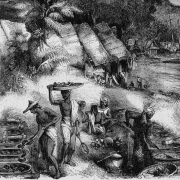
Image: Macassans at Victoria, Port Essington by HS Melville.
Stunning new research findings by a Geelong academic suggest Indigenous Australians converted partially to Islam practices up to 600 years ago.
Dr Dzavid Haveric, of Armstrong Creek, says Aborigines trading sea cucumber with Macassan fishermen from Indonesia blended Sufi-influenced Islam with Aboriginal Dreaming spirituality but the fact has been overlooked by previous historical studies.
The Charles Sturt University scholar said the Muslim-Indigenous interaction led to cultural exchanges, inter-marriages and the building of simple mosques – a cultural renaissance marked by a peaceful coexistence.
His findings challenge the notion that pre-colonial Australia was culturally isolated and that external influences were minimal or disruptive. They reframe Aboriginal history as part of a broader regional network of trade and cultural exchange, with lasting impacts on identity.
An adjunct research fellow, historian and author at CSU’s Centre for Islamic Studies and Civilisation, Dr Haveric is a leading expert on the history of Islam and Muslims in Australia. He has documented archaeological, anthropological and oral evidence to support his thesis.
“The central finding is that these encounters fostered peaceful coexistence and a cultural renaissance,” he said. “Though conversion to Islam remained incomplete among the Yolngu people, who selectively adopted Islamic practices while retaining their own traditions.
“The research challenges colonial narratives that isolated Australia and ignored early Muslim presence, highlighting how this history enriches contemporary understandings of multiculturalism and interfaith harmony.”
Dr Haveric urged a rethinking of Australian history to include the overlooked Muslim-Indigenous connections.
“Shared rituals, language and art show that Indigenous identity is intertwined with Islamic heritage, offering lessons for pluralism today,” he said.
Muslims from the Macassar region of Sulawesi in Indonesia visited northern Australia for trepang, or sea cucumber, fishing and trade from the 15th century onward.
Dr Haveric cited an “unfinished conversion” to Islam by the majority of Yolnu people.
“They adopted some Islamic practices but did not fully convert,” he said.
“Incomplete conversion describes the selective and partial adoption of Islamic practices by Yolnu people, where they integrated certain Islamic elements without fully abandoning their traditional beliefs.
“This reframes the historical narrative to acknowledge a nuanced, syncretic form of religious influence that persists in contemporary Yolnu identity.”
Dr Haveric said empirical evidence showed that Macassans built simple mosques in northern Australia, challenging colonial narratives that omitted religious structures from their accounts.
“According to their ancestral stories, they clarified to me that simple mosques were built by Macassans and that the Yolnu also visited them,” he said, citing the Aboriginal term ‘madain vaga’ for the structures built by Macassans as meaning ‘sacred home’.
He identified Sufism as a key factor in the “peaceful and flexible interaction” between Macassans and Yolnu, facilitating cultural exchange without a forced conversion.
“Sufism demonstrated its interfaith flexibility and also proved that Islam can peacefully coexist with Dreaming spirituality,” Dr Haveric said.
“This suggests that Sufi-oriented Islam provided a model for interfaith harmony that allowed Aboriginal spiritual traditions to persist alongside Islamic practices.”
Utilising archaeological, anthropological, etymological, and sociological data “along with old journal articles, colonial paintings, and comparison with Sufi Islam in Indonesia, too”, Dr Haveric said his research underscored a powerful historical revelation.
“For the first time in history of Australia, Macassans brought a cultural renaissance from the outside world.”


